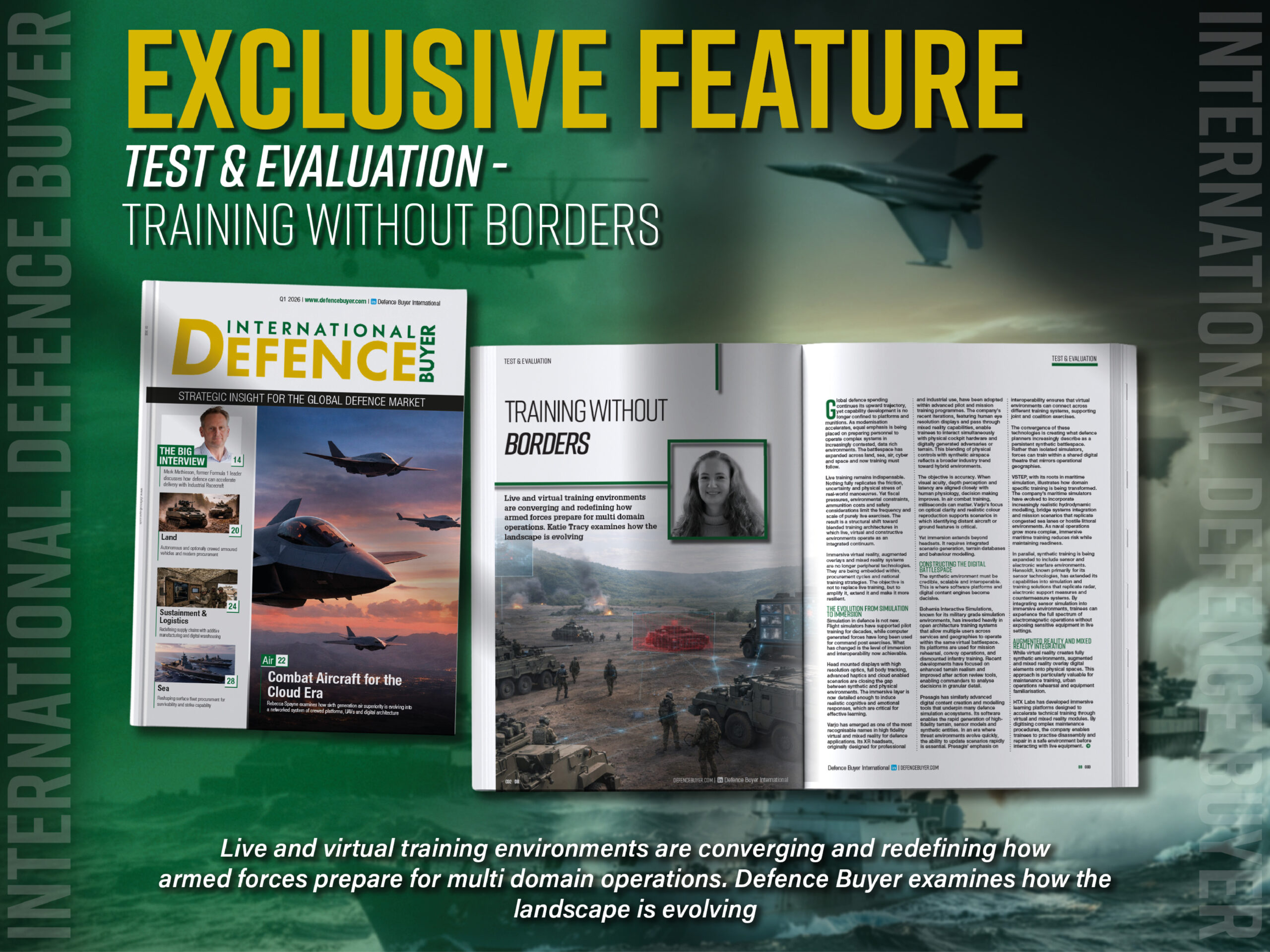

Live and virtual training environments are converging and redefining how armed forces prepare for multi domain operations. Katie Tracy examines how the landscape is evolving.
Global defence spending continues its upward trajectory, yet capability development is no longer confined to platforms and munitions. As modernisation accelerates, equal emphasis is being placed on preparing personnel to operate complex systems in increasingly contested, data rich environments. The battlespace has expanded across land, sea, air, cyber and space and now training must follow.
Live training remains indispensable. Nothing fully replicates the friction, uncertainty and physical stress of real-world manoeuvres. Yet fiscal pressures, environmental constraints, ammunition costs and safety considerations limit the frequency and scale of purely live exercises. The result is a structural shift toward blended training architectures in which live, virtual and constructive environments operate as an integrated continuum.
Immersive virtual reality, augmented overlays and mixed reality systems are no longer peripheral technologies. They are being embedded within, procurement cycles and national training strategies. The objective is not to replace live training, but to amplify it, extend it and make it more resilient.
The Evolution from Simulation to Immersion
Simulation in defence is not new. Flight simulators have supported pilot training for decades, while computer generated forces have long been used for command post exercises. What has changed is the level of immersion and interoperability now achievable.
Head mounted displays with high resolution optics, full body tracking, advanced haptics and cloud enabled scenarios are closing the gap between synthetic and physical environments. The immersive layer is now detailed enough to induce realistic cognitive and emotional responses, which are critical for effective learning.
Varjo has emerged as one of the most recognisable names in high fidelity virtual and mixed reality for defence applications. Its XR headsets, originally designed for professional and industrial use, have been adopted within advanced pilot and mission training programmes. The company’s recent iterations, featuring human eye resolution displays and pass through mixed reality capabilities, enable trainees to interact simultaneously with physical cockpit hardware and digitally generated adversaries or terrain. This blending of physical controls with synthetic airspace reflects a broader industry trend toward hybrid environments.
The objective is accuracy. When visual acuity, depth perception and latency are aligned closely with human physiology, decision making improves. In air combat training, milliseconds can matter. Varjo’s focus on optical clarity and realistic colour reproduction supports scenarios in which identifying distant aircraft or ground features is critical.
Yet immersion extends beyond headsets. It requires integrated scenario generation, terrain databases and behaviour modelling.
Constructing The Digital Battlespace
The synthetic environment must be credible, scalable and interoperable. This is where software platforms and digital content engines become decisive.
Bohemia Interactive Simulations, known for its military grade simulation environments, has invested heavily in open architecture training systems that allow multiple users across services and geographies to operate within the same virtual battlespace. Its platforms are used for mission rehearsal, convoy operations, and dismounted infantry training. Recent developments have focused on enhanced terrain realism and improved after action review tools, enabling commanders to analyse decisions in granular detail.
Presagis has similarly advanced digital content creation and modelling tools that underpin many defence simulation ecosystems. Its software enables the rapid generation of high-fidelity terrain, sensor models and synthetic entities. In an era where threat environments evolve quickly, the ability to update scenarios rapidly is essential. Presagis’ emphasis on interoperability ensures that virtual environments can connect across different training systems, supporting joint and coalition exercises.
The convergence of these technologies is creating what defence planners increasingly describe as a persistent synthetic battlespace. Rather than isolated simulators, forces can train within a shared digital theatre that mirrors operational geographies.
VSTEP, with its roots in maritime simulation, illustrates how domain specific training is being transformed. The company’s maritime simulators have evolved to incorporate increasingly realistic hydrodynamic modelling, bridge systems integration and mission scenarios that replicate congested sea lanes or hostile littoral environments. As naval operations grow more complex, immersive maritime training reduces risk while maintaining readiness.
In parallel, synthetic training is being expanded to include sensor and electronic warfare environments. Hensoldt, known primarily for its sensor technologies, has extended its capabilities into simulation and training solutions that replicate radar, electronic support measures and countermeasure systems. By integrating sensor simulation into immersive environments, trainees can experience the full spectrum of electromagnetic operations without exposing sensitive equipment in live settings….
Read the full article here