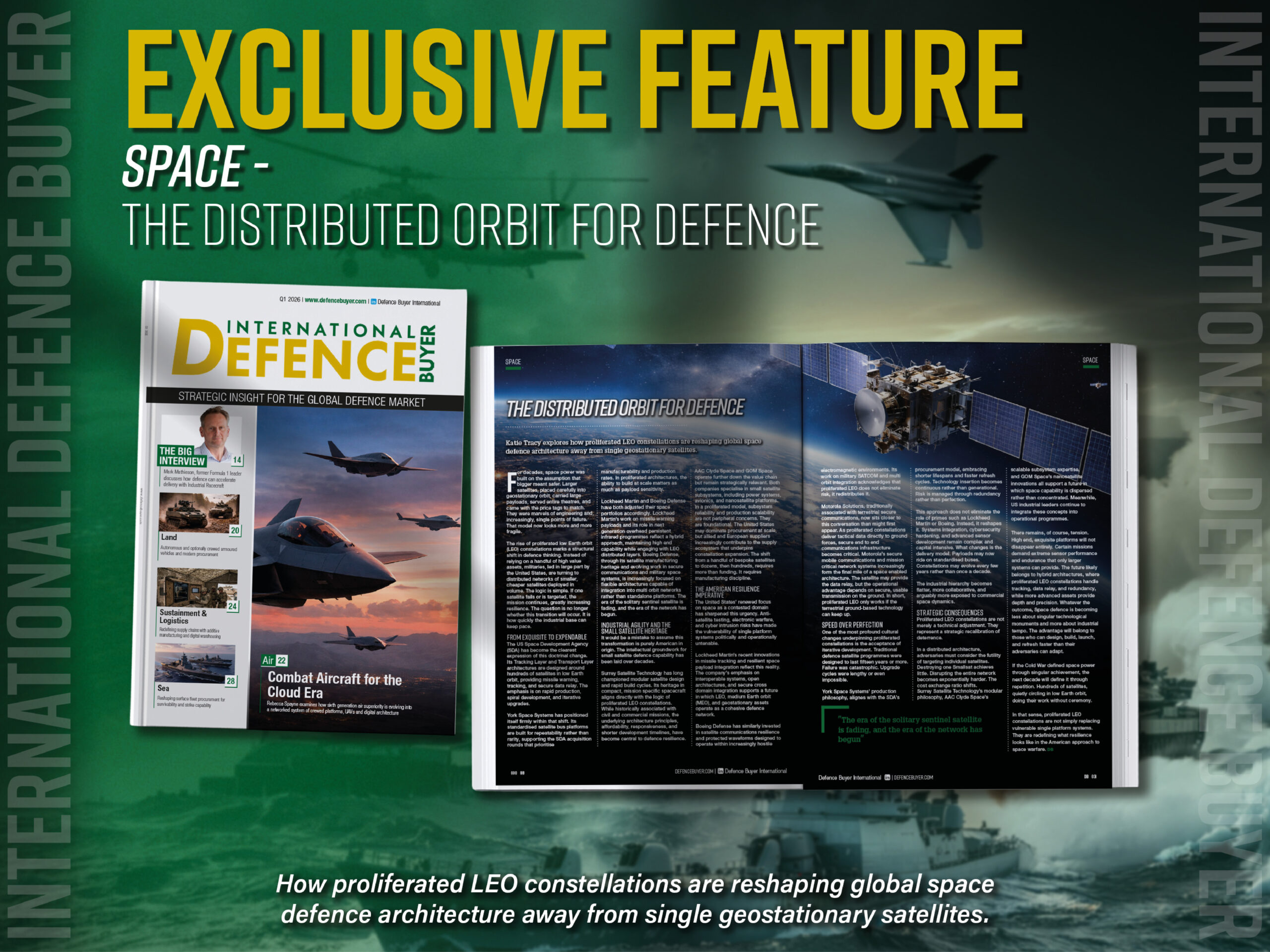

Katie Tracy explores how proliferated LEO constellations are reshaping global space defence architecture away from single geostationary satellites.
For decades, space power was built on the assumption that bigger meant safer. Larger satellites, placed carefully into geostationary orbit, carried large payloads, served entire theatres, and came with the price tags to match. They were marvels of engineering and, increasingly, single points of failure. That model now looks more and more fragile.
The rise of proliferated low Earth orbit (LEO) constellations marks a structural shift in defence thinking. Instead of relying on a handful of high value assets, militaries, led in large part by the United States, are turning to distributed networks of smaller, cheaper satellites deployed in volume. The logic is simple. If one satellite fails or is targeted, the mission continues, greatly increasing resilience. The question is no longer whether this transition will occur. It is how quickly the industrial base can keep pace.
From Exquisite to Expendable
The US Space Development Agency (SDA) has become the clearest expression of this doctrinal change. Its Tracking Layer and Transport Layer architectures are designed around hundreds of satellites in low Earth orbit, providing missile warning, tracking, and secure data relay. The emphasis is on rapid production, spiral development, and iterative upgrades.
York Space Systems has positioned itself firmly within that shift. Its standardised satellite bus platforms are built for repeatability rather than rarity, supporting the SDA acquisition rounds that prioritise manufacturability and production rates. In proliferated architectures, the ability to build at scale matters as much as payload sensitivity.
Lockheed Martin and Boeing Defense have both adjusted their space portfolios accordingly. Lockheed Martin’s work on missile warning payloads and its role in next generation overhead persistent infrared programmes reflect a hybrid approach, maintaining high end capability while engaging with LEO distributed layers. Boeing Defense, through its satellite manufacturing heritage and evolving work in secure communications and military space systems, is increasingly focused on flexible architectures capable of integration into multi orbit networks rather than standalone platforms. The era of the solitary sentinel satellite is fading, and the era of the network has begun.
Industrial Agility and the Small Satellite Heritage
It would be a mistake to assume this transformation is purely American in origin. The intellectual groundwork for small satellite defence capability has been laid over decades.
Surrey Satellite Technology has long championed modular satellite design and rapid build cycles. Its heritage in compact, mission specific spacecraft aligns directly with the logic of proliferated LEO constellations. While historically associated with civil and commercial missions, the underlying architecture principles, affordability, responsiveness, and shorter development timelines, have become central to defence resilience.
AAC Clyde Space and GOM Space operate further down the value chain but remain strategically relevant. Both companies specialise in small satellite subsystems, including power systems, avionics, and nanosatellite platforms. In a proliferated model, subsystem reliability and production scalability are not peripheral concerns. They are foundational. The United States may dominate procurement at scale, but allied and European suppliers increasingly contribute to the supply ecosystem that underpins constellation expansion. The shift from a handful of bespoke satellites to dozens, then hundreds, requires more than funding. It requires manufacturing discipline.
The American Resilience Imperative
The United States’ renewed focus on space as a contested domain has sharpened this urgency. Anti-satellite testing, electronic warfare, and cyber intrusion risks have made the vulnerability of single platform systems politically and operationally untenable.
Lockheed Martin’s recent innovations in missile tracking and resilient space payload integration reflect this reality. The company’s emphasis on interoperable systems, open architectures, and secure cross domain integration supports a future in which LEO, medium Earth orbit (MEO), and geostationary assets operate as a cohesive defence network.
Boeing Defense has similarly invested in satellite communications resilience and protected waveforms designed to operate within increasingly hostile electromagnetic environments. Its work on military SATCOM and multi orbit integration acknowledges that proliferated LEO does not eliminate risk, it redistributes it.
Motorola Solutions, traditionally associated with terrestrial secure communications, now sits closer to this conversation than might first appear. As proliferated constellations deliver tactical data directly to ground forces, secure end to end communications infrastructure becomes critical. Motorola’s secure mobile communications and mission critical network systems increasingly form the final mile of a space enabled architecture. The satellite may provide the data relay, but the operational advantage depends on secure, usable transmission on the ground. In short, proliferated LEO only works if the terrestrial ground-based technology can keep up.
Read the full article