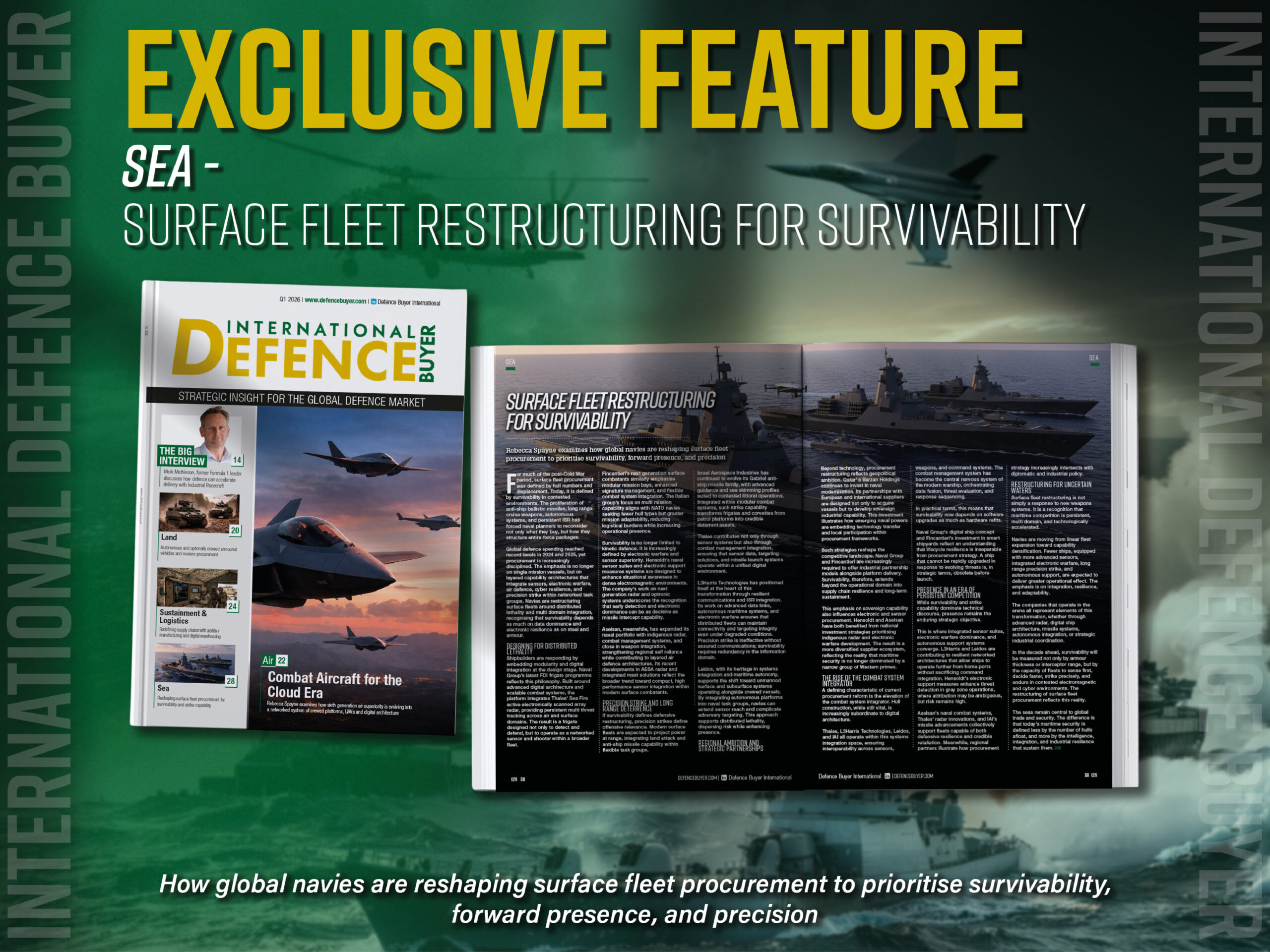

Rebecca Spayne examines how global navies are reshaping surface fleet procurement to prioritise survivability, forward presence, and precision strike capability in an era of accelerated technological change.
For much of the post-Cold War period, surface fleet procurement was defined by hull numbers and displacement. Today, it is defined by survivability in contested environments. The proliferation of anti-ship ballistic missiles, long range cruise weapons, autonomous systems, and persistent ISR has forced naval planners to reconsider not only what they buy, but how they structure entire force packages.
Global defence spending reached record levels in 2024 and 2025, yet procurement is increasingly disciplined. The emphasis is no longer on single mission vessels, but on layered capability architectures that integrate sensors, electronic warfare, air defence, cyber resilience, and precision strike within networked task groups. Navies are restructuring surface fleets around distributed lethality and multi domain integration, recognising that survivability depends as much on data dominance and electronic resilience as on steel and armour.
This shift is visible across Europe, the Middle East, and the Indo Pacific, where major primes and systems integrators are repositioning themselves not merely as shipbuilders, but as architects of survivable combat ecosystems.
Designing for Distributed Lethality
Shipbuilders are responding by embedding modularity and digital integration at the design stage. Naval Group’s latest FDI frigate programme reflects this philosophy. Built around advanced digital architecture and scalable combat systems, the platform integrates Thales’ Sea Fire active electronically scanned array radar, providing persistent multi threat tracking across air and surface domains. The result is a frigate designed not only to detect and defend, but to operate as a networked sensor and shooter within a broader fleet.
Fincantieri’s next generation surface combatants similarly emphasise modular mission bays, enhanced signature management, and flexible combat system integration. The Italian group’s focus on multi mission capability aligns with NATO navies seeking fewer hull types but greater mission adaptability, reducing logistical burdens while increasing operational presence.
Survivability is no longer limited to kinetic defence. It is increasingly defined by electronic warfare and sensor superiority. Hensoldt’s naval sensor suites and electronic support measures systems are designed to enhance situational awareness in dense electromagnetic environments. The company’s work on next generation radar and optronic systems underscores the recognition that early detection and electronic dominance can be as decisive as missile intercept capability.
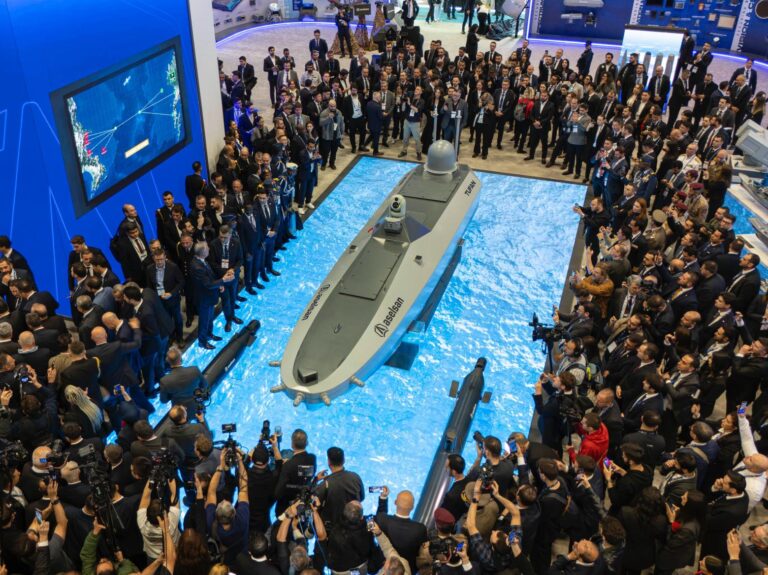
Aselsan, meanwhile, has expanded its naval portfolio with indigenous radar, combat management systems, and close in weapon integration, strengthening regional self reliance while contributing to layered air defence architectures. Its recent developments in AESA radar and integrated mast solutions reflect the broader trend toward compact, high performance sensor integration within modern surface combatants.
Precision Strike and Long Range Deterrence
If survivability defines defensive restructuring, precision strikes define offensive relevance. Modern surface fleets are expected to project power at range, integrating land attack and anti-ship missile capability within flexible task groups.
Israel Aerospace Industries has continued to evolve its Gabriel anti-ship missile family, with advanced guidance and sea skimming profiles suited to contested littoral operations. Integrated within modular combat systems, such strike capability transforms frigates and corvettes from patrol platforms into credible deterrent assets.
Thales contributes not only through sensor systems but also through combat management integration, ensuring that sensor data, targeting solutions, and missile launch systems operate within a unified digital environment. The ability to shorten sensor to shooter timelines is now central to naval doctrine.
L3Harris Technologies has positioned itself at the heart of this transformation through resilient communications and ISR integration. Its work on advanced data links, autonomous maritime systems, and electronic warfare ensures that distributed fleets can maintain connectivity and targeting integrity even under degraded conditions. Precision strike is ineffective without assured communications; survivability requires redundancy in the information domain.
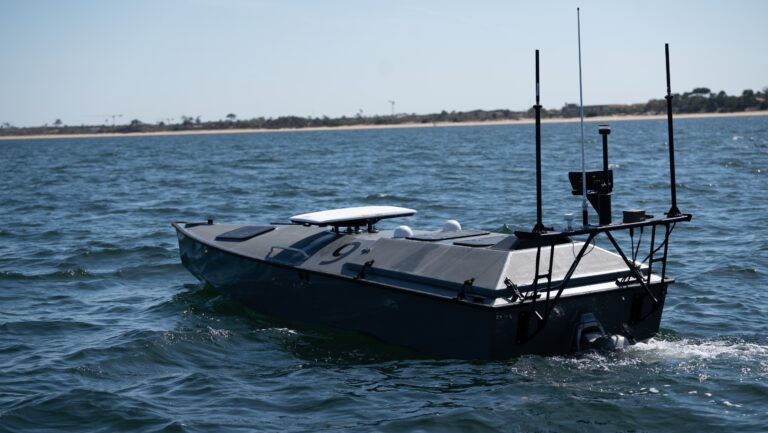
Leidos, with its heritage in systems integration and maritime autonomy, supports the shift toward unmanned surface and subsurface systems operating alongside crewed vessels. By integrating autonomous platforms into naval task groups, navies can extend sensor reach and complicate adversary targeting. This approach supports distributed lethality, dispersing risk while enhancing presence.
Regional Ambition and Strategic Partnerships
Beyond technology, procurement restructuring reflects geopolitical ambition. Qatar’ s Barzan Holdings continues to invest in naval modernisation. Its partnerships with European and international suppliers are designed not only to acquire vessels but to develop sovereign industrial capability. This investment illustrates how emerging naval powers are embedding technology transfer and local participation within procurement frameworks.
Such strategies reshape the competitive landscape. Naval Group and Fincantieri are increasingly required to offer industrial partnership models alongside platform delivery. Survivability, therefore, extends beyond the operational domain into supply chain resilience and long-term sustainment.
This emphasis on sovereign capability also influences electronic and sensor procurement. Hensoldt and Aselsan have both benefited from national investment strategies prioritising indigenous radar and electronic warfare development. The result is a more diversified supplier ecosystem, reflecting the reality that maritime security is no longer dominated by a narrow group of Western primes.
The Rise of the Combat System Integrator
A defining characteristic of current procurement reform is the elevation of the combat system integrator. Hull construction, while still vital, is increasingly subordinate to digital architecture.
Thales, L3Harris Technologies, Leidos, and IAI all operate within this systems integration space, ensuring interoperability across sensors, weapons, and command systems. The combat management system has become the central nervous system of the modern warship, orchestrating data fusion, threat evaluation, and response sequencing.
In practical terms, this means that survivability now depends on software upgrades as much as hardware refits. Digital twin modelling, predictive maintenance analytics, and AI assisted threat recognition are gradually becoming embedded within surface fleet management.
Naval Group’s digital ship concept and Fincantieri’s investment in smart shipyards reflect an understanding that lifecycle resilience is inseparable from procurement strategy. A ship that cannot be rapidly upgraded in response to evolving threats is, in strategic terms, obsolete before launch…
Read the full article here