

Mobility on the modern battlefield is no longer defined by the vehicle. Rebecca Spayne analyses mobile air defence and communications masts to adaptable platforms.
The modern land environment is making permanence increasingly difficult to defend. Persistent surveillance, uncrewed aircraft, electronic warfare and increasingly responsive fires mean that an asset which remains detectable in one position for too long can rapidly become vulnerable.
Mobility has consequently developed a meaning that extends well beyond the performance of the vehicle itself. Artillery must fire and relocate. Air defence needs to accompany manoeuvring forces. Communications equipment has to establish connectivity without creating an unnecessarily static target. Sensors need elevation, but the structures supporting them must be sufficiently quick to deploy and recover.
Across each of these requirements sits a common procurement challenge. Forces need systems that can be transported easily, established rapidly, adapted to different platforms and moved before an adversary can exploit the information their presence creates.
For industry, that is placing increasing importance on modularity and flexible integration.
Moving the effect
BAE Systems offers several examples of this shift, from mobile artillery and combat vehicles to the TRIDON Mk2 ground based air defence system. Speaking to Defence Buyer, Marc Collins, Vice President at BAE Systems, repeatedly returned to mobility as a defining requirement across the company’s land portfolio.
TRIDON Mk2 is a remotely controlled 40 millimetre air defence system designed to address threats including uncrewed aircraft, cruise missiles and conventional aircraft. Its architecture allows the system to be integrated onto different platforms, while BAE Systems says it can also be offloaded and operated remotely.
That flexibility is particularly relevant to counter UAS operations. Air defence cannot always be positioned around a fixed installation when the formation it is protecting is itself moving.
As Collins explained: “The TRIDON can be a standalone short range air defence system, or it can be integrated with a more comprehensive layered air defence system, but it is palletised. So it is very easy to integrate onto a military truck, onto a standalone platform. It can be towed behind the truck as well.”
BAE Systems also identifies the ability to fire while moving as part of the system’s flexibility. Collins linked that capability to TRIDON’s development from naval gun technology, where engaging from a moving platform is an established requirement.
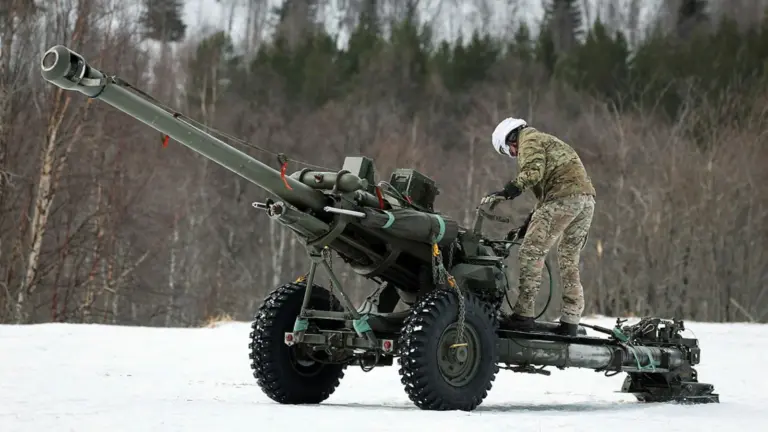
The underlying principle is broader than one air defence product. BAE Systems’ ARCHER artillery system, for example, is designed around rapid movement into and out of a firing position, while its M777 uses lightweight construction to support tactical deployment. BAE Systems describes ARCHER as capable of moving into action and firing in less than 30 seconds, before moving again within a further 30 seconds.
For land forces operating under persistent observation, those minutes and seconds increasingly matter.
Elevation without permanence
The same requirement appears in a very different part of the battlefield when communications and surveillance equipment needs to be elevated.
Finnish manufacturer Mast System designs composite telescopic masts for antennas, radios, surveillance cameras and other equipment. Its portfolio ranges from lightweight portable systems to field masts and automatic vehicle mounted solutions.
Ritta Sorsa, Sales Manager at Mast System, told Defence Buyer that one of its tripod systems weighs 13 kilogrammes while providing elevation to six metres. The use of glass and carbon fibre composite materials is intended to reduce weight compared with conventional aluminium or steel structures.
That seemingly straightforward reduction in mass has operational consequences. A mast that can be carried by personnel rather than requiring dedicated lifting equipment gives a unit greater freedom over where it establishes communications or surveillance.
At the other end of the range, Mast System has produced field masts reaching 50 metres. These can be transported on a vehicle using bracket systems that allow the mast to be tilted upright and deployed without first moving it away from the platform. The company’s dedicated vehicle masts are fully automatic and can be installed on vehicles, trailers, shelters and other mobile platforms.
Speed again becomes closely connected with survivability. Sorsa described the operational logic simply: “They deploy the mast. By the time they have sent their message, the enemy knows already where they are. So they are in a hurry to lower the mast down and drive away.”
This is an important consideration for communications procurement. Elevation improves line of sight and can extend communications or surveillance coverage, but a visible structure can also make a position easier to identify. The mast therefore has to perform its primary function without unnecessarily restricting the mobility of the unit using it.
Mast System says its larger automatic vehicle systems can extend to 20 metres and carry payloads of several hundred kilogrammes, while other vehicle systems reach 15 metres with payloads up to 150 kilogrammes.
The result is a useful illustration of how temporary infrastructure is changing. Deployable no longer necessarily means static.