
Rebecca Spayne of Defence Buyer examines how technology is reshaping land-based strike capabilities in the Modern Battlespace
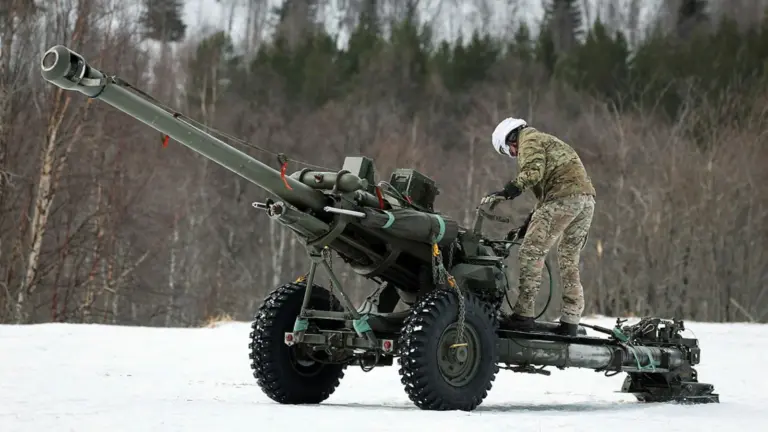
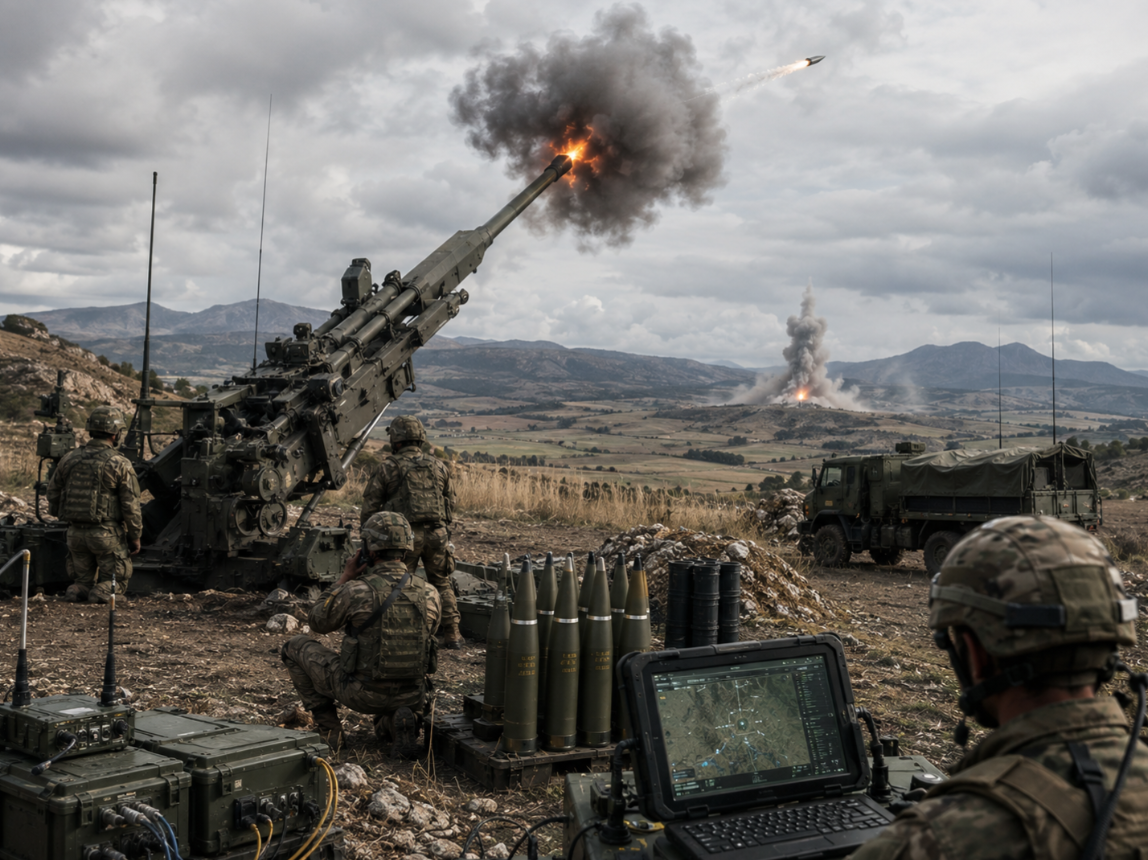
Modern artillery is undergoing one of the most significant transformations since the introduction of digital fire control. Advances in precision guidance, ammunition design, sensor integration, and networked targeting are redefining how land forces deliver effects across increasingly complex operational environments.
The Evolution of Land Based Firepower
For decades, artillery has remained one of the most decisive elements of land warfare. While armoured vehicles and infantry formations often receive the greatest public attention, military planners have consistently viewed indirect fire systems as a critical determinant of battlefield success.
What has changed in recent years is not the importance of artillery itself, but the technologies that underpin it. The traditional model of massed fires delivered against area targets is increasingly being supplemented by precision engagement capabilities designed to achieve greater effects with fewer rounds.
This shift is being driven by several converging factors. Modern armed forces face growing pressure to increase operational effectiveness while managing ammunition expenditure, logistical burden, and force survivability. At the same time, advances in sensors, communications networks, and guidance technologies have created opportunities to dramatically improve strike accuracy.
The result is a new generation of artillery and munitions systems capable of engaging targets at extended ranges while maintaining significantly higher levels of precision than previous generations.
Precision fires have consequently become a central component of military modernisation programmes worldwide. Rather than relying solely on volume of fire, commanders increasingly seek the ability to engage high value targets rapidly, accurately, and with minimal collateral effects.
This evolution extends beyond individual weapon systems. It encompasses the entire kill chain, from target detection and identification through to fire control, engagement, battle damage assessment, and re-engagement if required.
The modern artillery battlefield is therefore as much about information superiority as it is about kinetic effect.
Precision Munitions Move into the Mainstream
Perhaps the most significant development in land based fires has been the increasing availability of guided ammunition.
Historically, precision guided munitions were often reserved for specialised missions due to their cost and complexity. Today, advances in manufacturing, electronics miniaturisation, and guidance technologies have made precision engagement increasingly accessible across a wider range of artillery platforms.
Manufacturers such as BAE Systems, Diehl Defence, General Dynamics Ordnance and Tactical Systems, and Rheinmetall have invested heavily in the development of precision artillery ammunition designed to improve first round effectiveness and reduce ammunition consumption.
Modern projectile designs may incorporate GPS guidance, inertial navigation systems, terminal seekers, or combinations of multiple technologies to improve resilience against disruption and environmental factors. The operational benefits are substantial.
Higher accuracy reduces the number of rounds required to achieve a desired effect. This decreases logistical demand, lowers transportation requirements, and enables forces to sustain operations for longer periods with reduced resupply burden.
In high intensity operations, where ammunition expenditure can become a significant challenge, such efficiencies are increasingly valuable.
Furthermore, precision engagement allows commanders to prosecute targets in complex environments where traditional area fire approaches may be less appropriate.
Rather than replacing conventional ammunition entirely, guided munitions are increasingly viewed as complementary tools within a broader fires portfolio, enabling commanders to select the most suitable effect for each mission.
Extending Range Without Sacrificing Accuracy
Alongside precision, range has become another major focus of artillery development. Modern operational concepts increasingly emphasise long range engagement to create stand-off advantages and increase force survivability. The ability to strike targets at greater distances can disrupt enemy command structures, logistics hubs, air defence systems, and manoeuvre formations before they reach effective engagement positions.
Achieving extended range, however, presents significant technical challenges. Aerodynamics, propulsion technologies, projectile stability, and environmental variables all influence performance. As engagement distances increase, maintaining accuracy becomes increasingly complex.
This has prompted significant investment across the defence industry.
Companies such as Rheinmetall, BAE Systems, and General Dynamics Ordnance and Tactical Systems continue to explore technologies including rocket assisted projectiles, base bleed designs, enhanced propellant formulations, and advanced guidance systems to increase effective engagement ranges.
The objective is not simply to fire further. It is to maintain operationally relevant levels of precision throughout the engagement envelope.
This distinction is critical. Extended range without corresponding accuracy improvements offers limited operational value. Modern programmes therefore focus on achieving both simultaneously.
The convergence of range and precision is creating new possibilities for deep fires operations that were previously associated primarily with air power or missile forces.
Fire Control Systems Become the Centre of Capability
While munitions often attract attention, the effectiveness of modern artillery increasingly depends on the sophistication of fire control systems.
Digitalisation has transformed the way artillery units plan and execute missions. Modern fire control architectures integrate sensor feeds, meteorological data, terrain information, positioning systems, communications networks, and ammunition performance models into a unified engagement process.
This allows firing solutions to be generated more rapidly and with greater accuracy than was possible using traditional methods.
The reduction in sensor to shooter timelines has become particularly important. In contemporary operations, target opportunities may exist only briefly before adversaries relocate, disperse, or employ countermeasures. Rapid targeting cycles therefore represent a significant operational advantage.
Several defence manufacturers have invested heavily in digital fire control technologies designed to support this requirement. Increasing automation within the targeting process enables artillery units to respond faster while reducing operator workload.
Importantly, human decision making remains central to engagement authority, particularly where complex operational considerations are involved.
Automation is primarily focused on accelerating data processing and improving situational awareness rather than replacing command judgement.
The future of artillery effectiveness will likely depend as much on information processing capability as on projectile performance.
Counter Battery Threats Drive Survivability Innovation
The growing sophistication of counter battery systems has created new challenges for artillery operators.
Modern surveillance radars, acoustic sensors, electronic warfare capabilities, and unmanned systems can rapidly identify firing positions and enable retaliatory engagement. As a result, survivability has become a major design consideration.
Shoot and scoot concepts continue to influence platform development, with increasing emphasis on rapid deployment, engagement, and displacement.
Vehicle mobility, automated loading systems, digital fire control, and reduced crew requirements all contribute to shortening exposure times.
Rheinmetall and BAE Systems, among others, have invested in technologies that support greater operational agility for artillery units.
Automation plays a particularly important role. Reducing the time required to enter firing positions, execute missions, and relocate can significantly enhance survivability against counter battery threats.
Networked operations also contribute by enabling distributed fire missions across multiple platforms rather than concentrating assets in predictable locations.
This reflects a broader trend toward dispersed operations across the land domain.
Medium Calibre Systems Bridge Multiple Operational Roles
While discussions of artillery often focus on large calibre systems, medium calibre weapon technologies continue to play an important role across modern land forces.
Manufacturers including AEI Systems and MSI Defence Systems have developed advanced weapon solutions capable of supporting a wide range of applications, from force protection and air defence support to counter unmanned aerial system operations.
Advances in ammunition design, stabilisation technologies, fire control integration, and targeting systems have significantly enhanced the effectiveness of medium calibre platforms.
The emergence of unmanned aerial threats has further increased interest in highly responsive weapon systems capable of engaging fast moving and difficult targets.
Modern medium calibre systems increasingly operate as part of integrated defensive architectures, sharing sensor information and engagement data across networked environments.
Their value lies in versatility. Rather than serving a single purpose, these systems can contribute to multiple mission sets while maintaining relatively modest logistical demands.
As armed forces seek greater flexibility from deployed capabilities, such adaptability is becoming increasingly attractive.
The Growing Importance of Ammunition Engineering
The performance of artillery systems is increasingly influenced by advances in ammunition science.
Manufacturers are pursuing improvements across multiple areas, including lethality, survivability, storage life, insensitive munitions compliance, and environmental resilience.
General Dynamics Ordnance and Tactical Systems, Diehl Defence, and Rheinmetall have all been active in developing ammunition technologies designed to improve operational effectiveness while addressing evolving safety requirements.
Insensitive munitions technologies are particularly important. These designs reduce the likelihood of unintended detonation following impact, fire, or other hazards, improving both battlefield and storage safety.
Materials science is also enabling improvements in projectile design, fragmentation characteristics, and structural performance.
The cumulative effect of these innovations is often greater than any individual technological breakthrough.
Incremental improvements across multiple performance areas can significantly enhance overall capability when applied across large ammunition inventories.
Networked Fires and the Digital Battlefield
The future of artillery is increasingly linked to broader digital transformation initiatives. Sensor networks, unmanned systems, battlefield management platforms, and artificial intelligence enabled decision support tools are changing how targets are identified and engaged.
Rather than operating as isolated assets, artillery systems are becoming nodes within larger operational networks.
Target information may originate from unmanned aerial systems, ground sensors, reconnaissance units, electronic surveillance platforms, or allied forces.
This information can then be distributed across command networks and converted into firing solutions within compressed timelines.
The ability to connect sensors and shooters efficiently is becoming a defining characteristic of modern firepower.
Data quality, communications resilience, cybersecurity, and interoperability are therefore emerging as critical capability areas.
Future success may depend less on individual platform performance and more on the effectiveness of the wider ecosystem in which those platforms operate.
A New Era for Land Based Precision Fires
Artillery remains one of the most influential capabilities available to land forces, but its character is changing rapidly.
Precision guidance, extended range, digital fire control, advanced ammunition engineering, and networked targeting are collectively reshaping how military organisations think about firepower.
The most successful future systems will not necessarily be those that fire the furthest or deliver the greatest volume of munitions. Instead, they will be those capable of integrating seamlessly into broader operational networks while delivering accurate, responsive, and sustainable effects.
For defence planners, the challenge is increasingly one of balance. Range must be matched by accuracy. Firepower must be supported by survivability. Digital connectivity must be underpinned by resilience.
The companies investing in these areas today are helping define the next generation of land based strike capability.
As precision engagement becomes central to modern military operations, artillery is evolving from a predominantly kinetic capability into a highly networked technology domain, one where information, speed, and accuracy increasingly determine operational advantage.