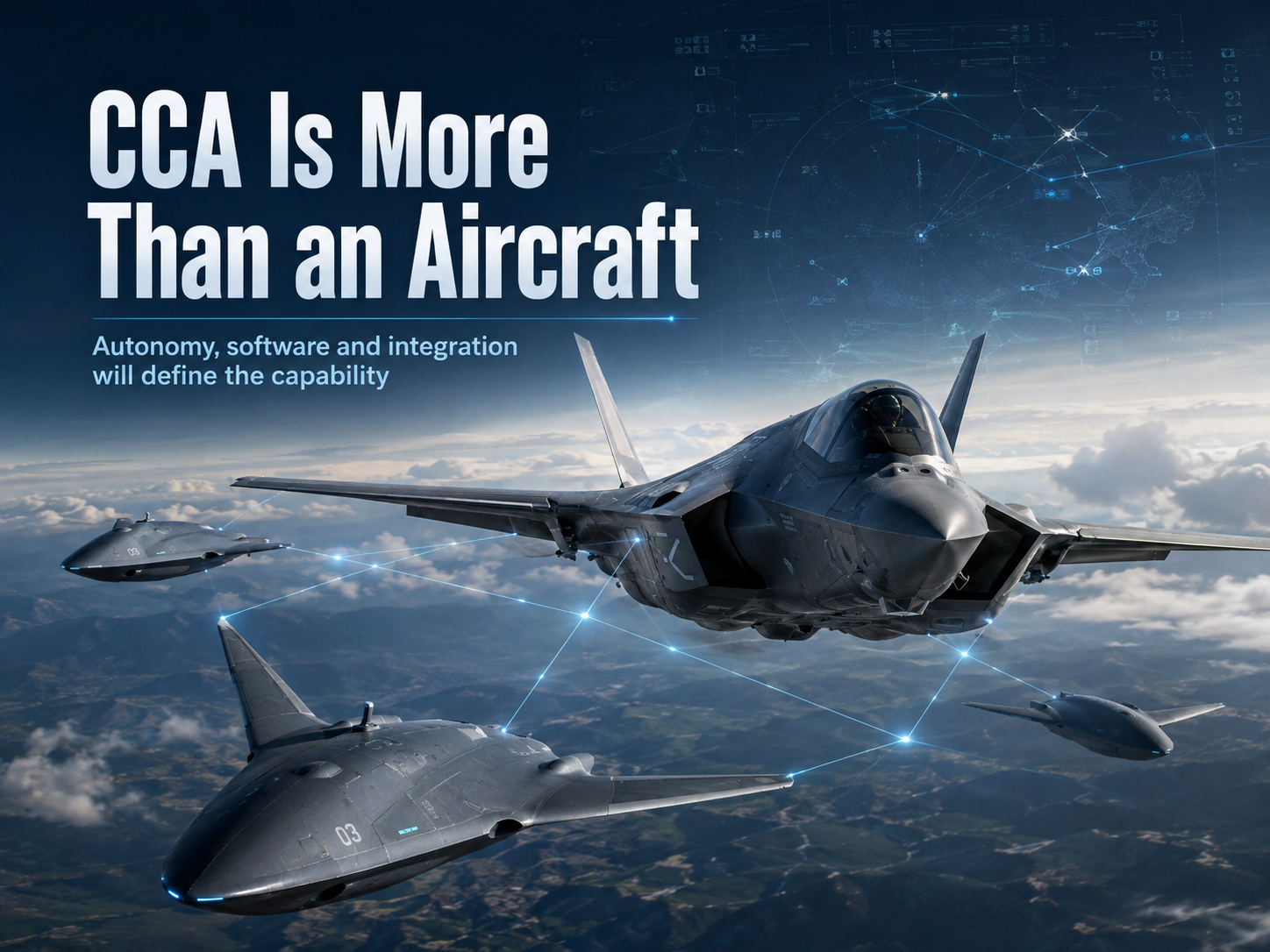

Collaborative Combat Aircraft are moving rapidly from aerospace concept to procurement discussion, but focusing exclusively on the aircraft risks overlooking the more difficult part of introducing the capability.
The real challenge will be integrating autonomy, sensors, weapons, communications, mission software and crewed aircraft into an operational system that commanders trust.
Developments during August illustrate the direction of travel. Boeing and Rheinmetall are positioning the MQ-28 Ghost Bat as a potential route towards Germany’s planned Collaborative Combat Aircraft capability, with Rheinmetall acting as a national system integrator. Their approach includes the potential integration of German sensors, weapons and mission software rather than treating the aircraft as a completely closed platform.
Saab, meanwhile, unveiled its full-scale A3-001 uncrewed combat air concept on 22 August. The company envisages potential roles including electronic warfare, suppression of enemy air defences and precision strike, operating alongside Gripen and future crewed aircraft. Saab intends to fly fighter-like uncrewed demonstrators before 2030.
Integration will define capability
Both developments point towards the same issue. An uncrewed aircraft does not automatically create collaborative combat capability.
The value comes from what it can do within a wider force.
That means decisions about how tasks are divided between pilot and autonomous system, how targets are identified, what information is exchanged and how weapons employment is controlled. It also means ensuring that new aircraft can communicate with current fighters, surveillance platforms, ground systems and allied networks.
Software may therefore become as important as aerodynamic performance.
Germany’s proposed approach to the MQ-28 is notable because national mission integration and intellectual property are part of the discussion. Boeing and Rheinmetall argue that German sensors and systems could be integrated domestically while using an existing aircraft as the development platform.
Sovereignty enters the specification
This creates another procurement question: who controls future upgrades?
Combat aircraft routinely remain in service for decades. An autonomous aircraft’s capabilities could change much more frequently through software, mission applications and new sensors.
For governments, control over those changes could become strategically important.
The UK is moving in a similar direction through its wider Future Combat Air System work. A £708 million contract announced in July specifically includes investment in artificial intelligence, advanced software and digital engineering alongside conventional combat-air technology. Around 600 UK companies and academic organisations form part of that programme’s supply chain.
Defence buyers should therefore resist treating CCA procurement as another aircraft competition.
Range, payload and survivability will matter, but so will software architecture, data ownership, integration rights, upgrade pathways and interoperability.
The aircraft will be visible. The architecture behind it may ultimately determine whether the capability works.