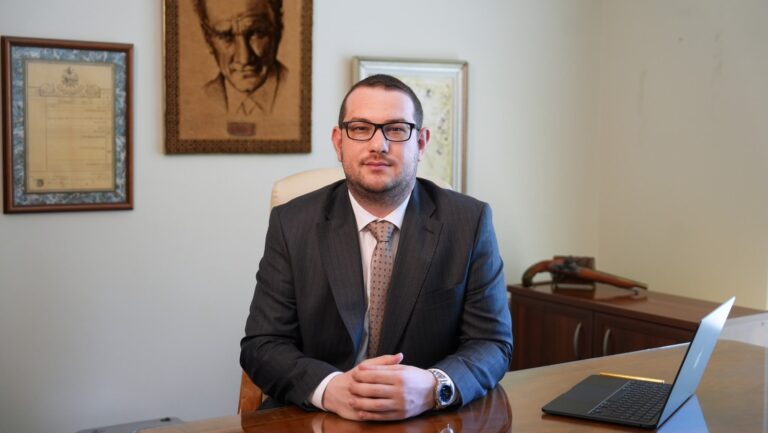
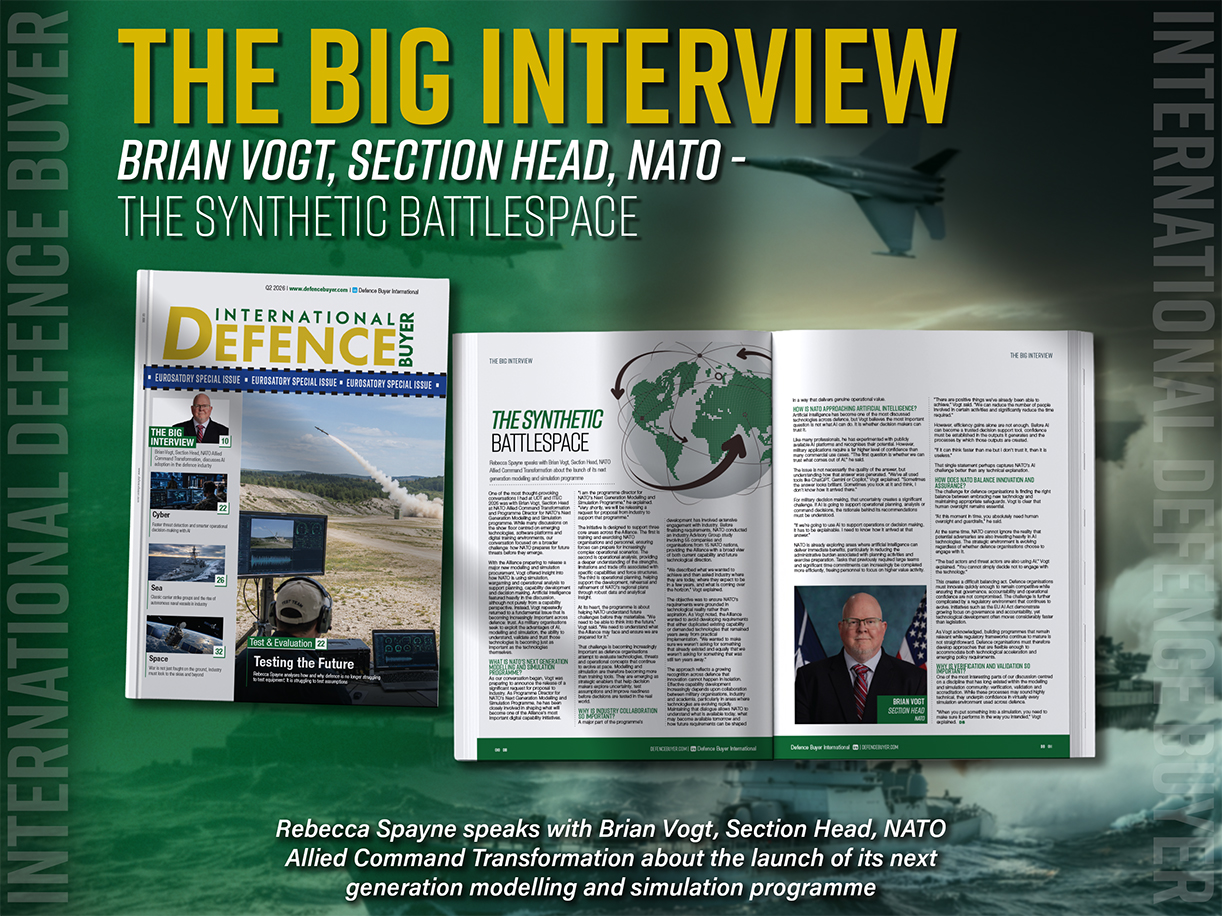

Rebecca Spayne speaks with Brian Vogt, Section Head, NATO Allied Command Transformation about the launch of its next generation modelling and simulation programme
One of the most thought-provoking conversations I had at UDT and ITEC 2025 was with Brian Vogt, Section Head at NATO Allied Command Transformation and Programme Director for NATO’s Next Generation Modelling and Simulation programme. While many discussions on the show floor centred on emerging technologies, software platforms and digital training environments, our conversation focused on a broader challenge: how NATO prepares for future threats before they emerge.
With the Alliance preparing to release a major new modelling and simulation procurement, Vogt offered insight into how NATO is using simulation, wargaming and operational analysis to support planning, capability development and decision making. Artificial intelligence featured heavily in the discussion, although not purely from a capability perspective. Instead, Vogt repeatedly returned to a fundamental issue that is becoming increasingly important across defence: trust. As military organisations seek to exploit the advantages of AI, modelling and simulation, the ability to understand, validate and trust those technologies is becoming just as important as the technologies themselves.
What is NATO’s Next Generation Modelling and Simulation Programme?
As our conversation began, Vogt was preparing to announce the release of a significant request for proposal to industry. As Programme Director for NATO’s Next Generation Modelling and Simulation Programme, he has been closely involved in shaping what will become one of the Alliance’s most important digital capability initiatives.
“I am the programme director for NATO’s Next Generation Modelling and Simulation Programme,” he explained. “Very shortly, we will be releasing a request for proposal from industry to support that programme.”
The initiative is designed to support three core areas across the Alliance. The first is training and exercising NATO organisations and personnel, ensuring forces can prepare for increasingly complex operational scenarios. The second is operational analysis, providing a deeper understanding of the strengths, limitations and trade offs associated with specific capabilities and force structures. The third is operational planning, helping support the development, rehearsal and refinement of NATO’s regional plans through robust data and analytical insight.
At its heart, the programme is about helping NATO understand future challenges before they materialise. “We need to be able to think into the future,” Vogt said. “We need to understand what the Alliance may face and ensure we are prepared for it.”
That challenge is becoming increasingly important as defence organisations attempt to evaluate technologies, threats and operational concepts that continue to evolve at pace. Modelling and simulation are therefore becoming more than training tools. They are emerging as strategic enablers that help decision makers explore uncertainty, test assumptions and improve readiness before decisions are tested in the real world.
Why is industry collaboration so important?
A major part of the programme’s development has involved extensive engagement with industry. Before finalising requirements, NATO conducted an Industry Advisory Group study involving 55 companies and organisations from 15 NATO nations, providing the Alliance with a broad view of both current capability and future technological direction.
“We described what we wanted to achieve and then asked industry where they are today, where they expect to be in a few years, and what is coming over the horizon,” Vogt explained.
The objective was to ensure NATO’s requirements were grounded in technological reality rather than aspiration. As Vogt noted, the Alliance wanted to avoid developing requirements that either duplicated existing capability or demanded technologies that remained years away from practical implementation. “We wanted to make sure we weren’t asking for something that already existed and equally that we weren’t asking for something that was still ten years away.”
The approach reflects a growing recognition across defence that innovation cannot happen in isolation. Effective capability development increasingly depends upon collaboration between military organisations, industry and academia, particularly in areas where technologies are evolving rapidly. Maintaining that dialogue allows NATO to understand what is available today, what may become available tomorrow and how future requirements can be shaped in a way that delivers genuine operational value.
How is NATO approaching artificial intelligence?
Artificial intelligence has become one of the most discussed technologies across defence, but Vogt believes the most important question is not what AI can do. It is whether decision makers can trust it.
Like many professionals, he has experimented with publicly available AI platforms and recognises their potential. However, military applications require a far higher level of confidence than many commercial use cases. “The first question is whether we can trust what comes out of AI,” he said.
The issue is not necessarily the quality of the answer, but understanding how that answer was generated. “We’ve all used tools like ChatGPT, Gemini or Copilot,” Vogt explained. “Sometimes the answer looks brilliant. Sometimes you look at it and think, I don’t know how it arrived there.”
For military decision making, that uncertainty creates a significant challenge. If AI is going to support operational planning, analysis or command decisions, the rationale behind its recommendations must be understood.
“If we’re going to use AI to support operations or decision making, it has to be explainable. I need to know how it arrived at that answer.”
NATO is already exploring areas where artificial intelligence can deliver immediate benefits, particularly in reducing the administrative burden associated with planning activities and exercise preparation. Tasks that previously required large teams and significant time commitments can increasingly be completed more efficiently, freeing personnel to focus on higher value activity. “There are positive things we’ve already been able to achieve,” Vogt said. “We can reduce the number of people involved in certain activities and significantly reduce the time required.”
However, efficiency gains alone are not enough. Before AI can become a trusted decision support tool, confidence must be established in the outputs it generates and the processes by which those outputs are created.
“If it can think faster than me but I don’t trust it, then it is useless.”
That single statement perhaps captures NATO’s AI challenge better than any technical explanation.
How does NATO balance innovation and assurance?
The challenge for defence organisations is finding the right balance between embracing new technology and maintaining appropriate safeguards. Vogt is clear that human oversight remains essential.
“At this moment in time, you absolutely need human oversight and guardrails,” he said.
At the same time, NATO cannot ignore the reality that potential adversaries are also investing heavily in AI technologies. The strategic environment is evolving regardless of whether defence organisations choose to engage with it.
“The bad actors and threat actors are also using AI,” Vogt explained. “You cannot simply decide not to engage with the technology.”
This creates a difficult balancing act. Defence organisations must innovate quickly enough to remain competitive while ensuring that governance, accountability and operational confidence are not compromised. The challenge is further complicated by a regulatory environment that continues to evolve. Initiatives such as the EU AI Act demonstrate growing focus on governance and accountability, yet technological development often moves considerably faster than legislation.
As Vogt acknowledged, building programmes that remain relevant while regulatory frameworks continue to mature is not straightforward. Defence organisations must therefore develop approaches that are flexible enough to accommodate both technological acceleration and emerging policy requirements.
Why is verification and validation so important?
One of the most interesting parts of our discussion centred on a discipline that has long existed within the modelling and simulation community: verification, validation and accreditation. While these processes may sound highly technical, they underpin confidence in virtually every simulation environment used across defence.
“When you put something into a simulation, you need to make sure it performs in the way you intended,” Vogt explained.
Verification and validation ensure that models behave as expected and accurately represent the systems or environments they are intended to replicate. Only then can decision makers place confidence in the outputs generated.
For decades, these principles have been fundamental to simulation programmes. Vogt believes the same approach must increasingly be applied to artificial intelligence.
“We need to understand how we verify, validate and accredit AI,” he said. “How do we make sure that what comes out of it is trustworthy?”