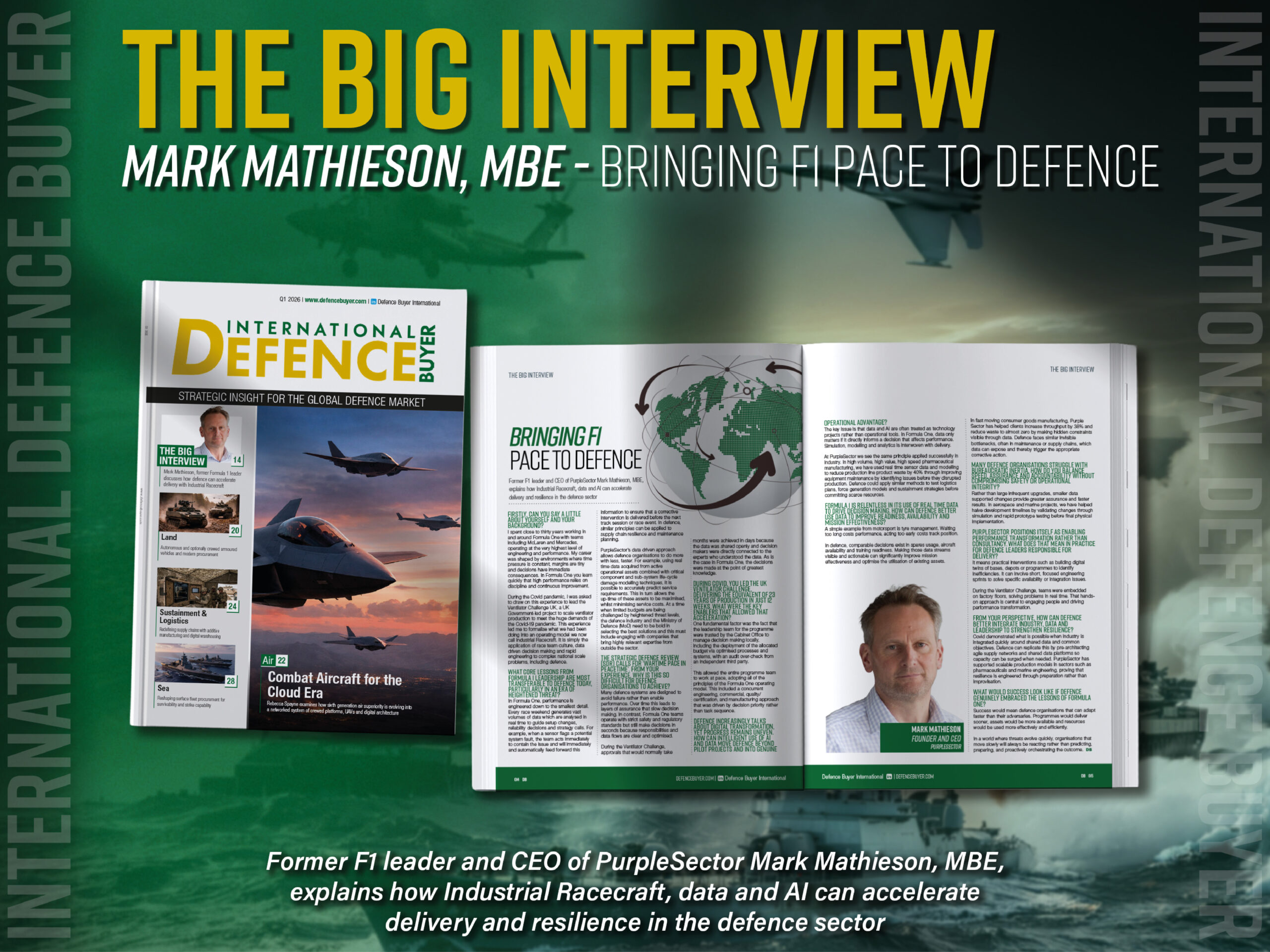

Former F1 leader and CEO of PurpleSector Mark Mathieson, MBE, explains how Industrial Racecraft, data and AI can accelerate delivery and resilience in the defence sector
Firstly, can you say a little about yourself and your background?
I spent close to thirty years working in and around Formula One with teams including McLaren and Mercedes, operating at the very highest level of engineering and performance. My career was shaped by environments where time pressure is constant, margins are tiny and decisions have immediate consequences. In Formula One you learn quickly that high performance relies on discipline and continuous improvement.
During the Covid pandemic, I was asked to draw on this experience to lead the Ventilator Challenge UK, a UK Government-led project to scale ventilator production to meet the huge demands of the Covid-19 pandemic. This experience led me to formalise what we had been doing into an operating model we now call Industrial Racecraft. It is simply the application of race team culture, data driven decision making and rapid engineering to complex national scale problems, including defence.
What core lessons from Formula 1 leadership are most transferable to defence today, particularly in an era of heightened threat?
In Formula One, performance is engineered down to the smallest detail. Every race weekend generates vast volumes of data which are analysed in real time to guide setup changes, reliability decisions and strategy calls. For example, when a sensor flags a potential system fault, the team acts immediately to contain the issue and will immediately and automatically feed forward this information to ensure that a corrective intervention is delivered before the next track session or race event. In defence, similar principles can be applied to supply chain resilience and maintenance planning.
PurpleSector’s data driven approach allows defence organisations to do more with less, faster. For example, using real time data acquired from active operational assets combined with critical component and sub-system life-cycle damage modelling techniques, it is possible to accurately predict service requirements. This in turn allows the up-time of these assets to be maximised, whilst minimising service costs. At a time when limited budgets are being challenged by heightened threat levels, the defence industry and the Ministry of Defence (MoD) need to be bold in selecting the best solutions and this must include engaging with companies that bring highly relevant expertise from outside the sector.
The Strategic Defence Review (SDR) calls for ‘wartime pace in peacetime’. From your experience, why is this so difficult for defence organisations to achieve?
Many defence systems are designed to avoid failure rather than enable performance. Over time this leads to layers of assurance that slow decision making. In contrast, Formula One teams operate with strict safety and regulatory standards but still make decisions in seconds because responsibilities and data flows are clear and optimised.
During the Ventilator Challenge, approvals that would normally take months were achieved in days because the data was shared openly and decision makers were directly connected to the experts who understood the data. As is the case in Formula One, the decisions were made at the point of greatest knowledge, i.e. by trusting the expert who is in possession of the right data, at the right time. Defence can achieve similar pace by simplifying decision pathways and aligning decision making authority with trusted data and relevant domain knowledge.
During Covid, you led the UK Ventilator Challenge, delivering the equivalent of 23 years of production in just 12 weeks. What were the key enablers that allowed that acceleration?
One fundamental factor was the fact that the leadership team for the programme were trusted by the Cabinet Office to manage decision making locally, including the deployment of the allocated budget via optimised processes and systems, with an audit over-check from an independent third party.
This allowed the entire programme team to work at pace, adopting all of the principles of the Formula One operating model. This included a concurrent engineering, commercial, quality/ certification, and manufacturing approach that was driven by decision priority rather than task sequence.
The net result was the truly astounding number of ventilators produced, the unit cost of which was less than the standard cost of the product prior to Covid, even when the entire investment cost of all other speculative ventilator projects was shared across this production volume.
Defence increasingly talks about digital transformation, yet progress remains uneven. How can intelligent use of AI and data move defence beyond pilot projects and into genuine operational advantage?
The key issue is that data and AI are often treated as technology projects rather than operational tools. In Formula One, data only matters if it directly informs a decision that affects performance. Simulation, modelling and analytics is interwoven with delivery.
At PurpleSector we see the same principle applied successfully in industry. In high volume, high value, high speed pharmaceutical manufacturing, we have used real time sensor data and modelling to reduce production line product waste by 40% through improving equipment maintenance by identifying issues before they disrupted production. Defence could apply similar methods to test logistics plans, force generation models and sustainment strategies before committing scarce resources…
Read the full interview: