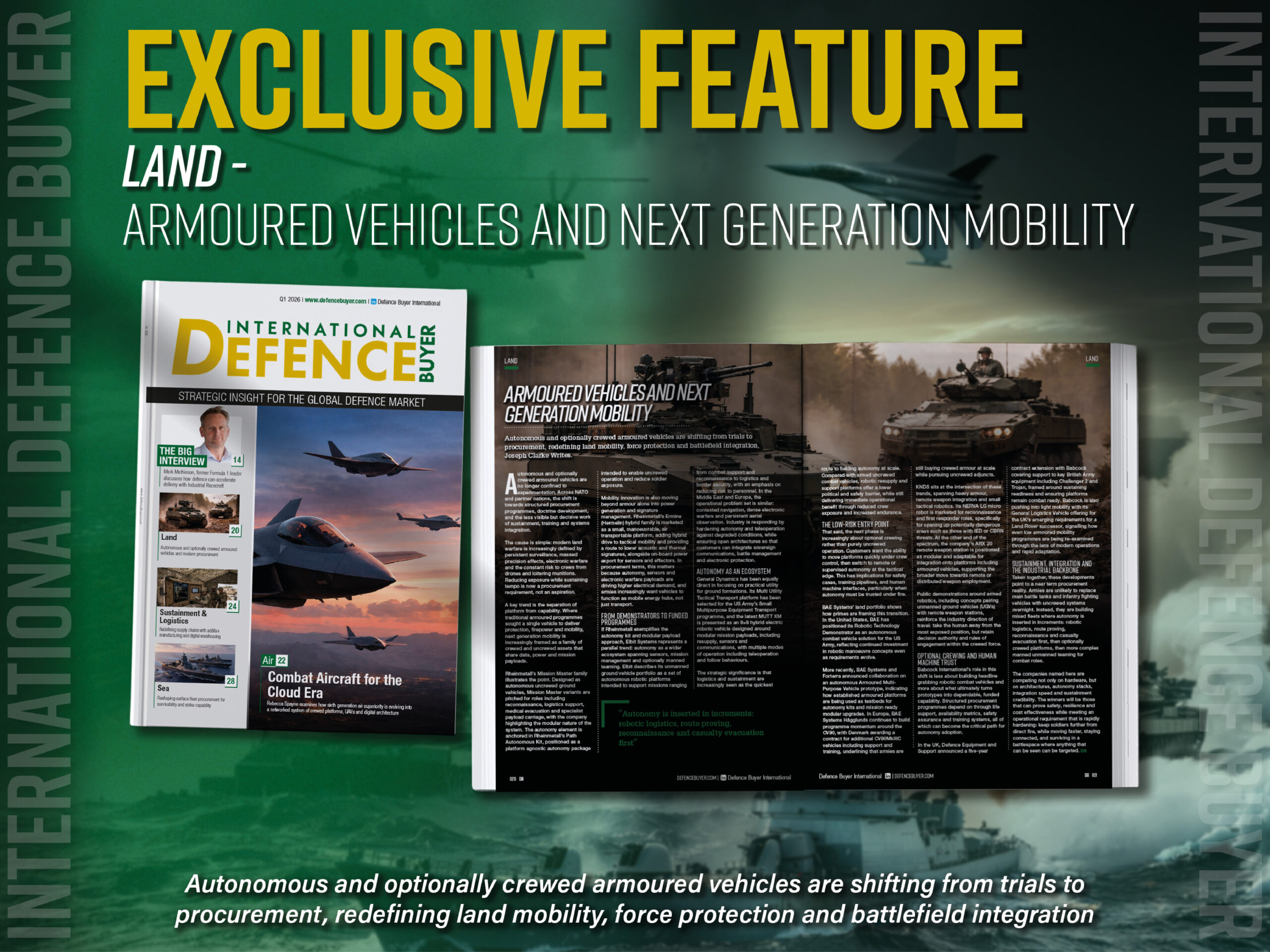

Autonomous and optionally crewed armoured vehicles are shifting from trials to procurement, redefining land mobility, force protection and battlefield integration, Joseph Clark Writes.
Autonomous and optionally crewed armoured vehicles are no longer confined to experimentation. Across NATO and partner nations, the shift is towards structured procurement programmes, doctrine development, and the less visible but decisive work of sustainment, training and systems integration.
The cause is simple: modern land warfare is increasingly defined by persistent surveillance, massed precision effects, electronic warfare and the constant risk to crews from drones and loitering munitions. Reducing exposure while sustaining tempo is now a procurement requirement, not an aspiration.
A key trend is the separation of platform from capability. Where traditional armoured programmes sought a single vehicle to deliver protection, firepower and mobility, next generation mobility is increasingly framed as a family of crewed and uncrewed assets that share data, power and mission payloads.
Rheinmetall’s Mission Master family illustrates the point. Designed as autonomous uncrewed ground vehicles, Mission Master variants are pitched for roles including reconnaissance, logistics support, medical evacuation and specialist payload carriage, with the company highlighting the modular nature of the system. The autonomy element is anchored in Rheinmetall’s Path Autonomous Kit, positioned as a platform agnostic autonomy package intended to enable uncrewed operation and reduce soldier exposure.
Mobility innovation is also moving beyond armour alone into power generation and signature management. Rheinmetall’s Ermine (Hermelin) hybrid family is marketed as a small, manoeuvrable, air transportable platform, adding hybrid drive to tactical mobility and providing a route to lower acoustic and thermal signatures, alongside on-board power export for sensors and effectors. In procurement terms, this matters because autonomy, sensors and electronic warfare payloads are driving higher electrical demand, and armies increasingly want vehicles to function as mobile energy hubs, not just transport.
From Demonstrators to Funded Programmes
If Rheinmetall exemplifies the autonomy kit and modular payload approach, Elbit Systems represents a parallel trend: autonomy as a wider ecosystem spanning sensors, mission management and optionally manned teaming. Elbit describes its unmanned ground vehicle portfolio as a set of autonomous robotic platforms intended to support missions ranging from combat support and reconnaissance to logistics and border security, with an emphasis on reducing risk to personnel. In the Middle East and Europe, the operational problem set is similar: contested navigation, dense electronic warfare and persistent aerial observation. Industry is responding by hardening autonomy and teleoperation against degraded conditions, while ensuring open architectures so that customers can integrate sovereign communications, battle management and electronic protection.
Autonomy as an Ecosystem
General Dynamics has been equally direct in focusing on practical utility for ground formations. Its Multi Utility Tactical Transport platform has been selected for the US Army’s Small Multipurpose Equipment Transport programme, and the latest MUTT XM is presented as an 8×8 hybrid electric robotic vehicle designed around modular mission payloads, including resupply, sensors and communications, with multiple modes of operation including teleoperation and follow behaviours.
The strategic significance is that logistics and sustainment are increasingly seen as the quickest route to fielding autonomy at scale. Compared with armed uncrewed combat vehicles, robotic resupply and support platforms offer a lower political and safety barrier, while still delivering immediate operational benefit through reduced crew exposure and increased endurance.
The Low-Risk Entry Point
That said, the next phase is increasingly about optional crewing rather than purely uncrewed operation. Customers want the ability to move platforms quickly under crew control, then switch to remote or supervised autonomy at the tactical edge. This has implications for safety cases, training pipelines, and human machine interfaces, particularly when autonomy must be trusted under fire.
BAE Systems’ land portfolio shows how primes are framing this transition. In the United States, BAE has positioned its Robotic Technology Demonstrator as an autonomous combat vehicle solution for the US Army, reflecting continued investment in robotic manoeuvre concepts even as requirements evolve.
More recently, BAE Systems and Forterra announced collaboration on an autonomous Armoured Multi-Purpose Vehicle prototype, indicating how established armoured platforms are being used as testbeds for autonomy kits and mission ready modular upgrades. In Europe, BAE Systems Hägglunds continues to build programme momentum around the CV90, with Denmark awarding a contract for additional CV90MkIIIC vehicles including support and training, underlining that armies are still buying crewed armour at scale while pursuing uncrewed adjuncts.
KNDS sits at the intersection of these trends, spanning heavy armour, remote weapon integration and small tactical robotics. Its NERVA LG micro robot is marketed for reconnaissance and first responder roles, specifically for opening up potentially dangerous areas such as those with IED or CBRN threats. At the other end of the spectrum, the company’s ARX 20 remote weapon station is positioned as modular and adaptable for integration onto platforms including armoured vehicles, supporting the broader move towards remote or distributed weapon employment.
Public demonstrations around armed robotics, including concepts pairing unmanned ground vehicles (UGVs) with remote weapon stations, reinforce the industry direction of travel: take the human away from the most exposed position, but retain decision authority and rules of engagement within the crewed force….
Read the full article here