
L3Harris has released a blog detailing somer of America’s biggest innovations that helped change the world of defence.
For 250 years, the United States has been a launchpad for ideas that didn’t just change America—they changed the world. From breakthrough inventions to engineering feats once thought impossible, American innovation has repeatedly redefined how people communicate, travel, explore, build and protect.
But some of the most important breakthroughs in American innovation didn’t happen exactly the way people expected. A few were discovered by accident. Others evolved into technologies their inventors never could have imagined.
That story is still unfolding today.
Across space, air, land, sea and cyber, L3Harris continues building on generations of American ingenuity with technologies that help connect, inform, protect and power critical missions. Here are six innovation stories that are honestly kind of wild.
1. Radar was partially discovered by accident, and it changed modern warfare forever.
In the early 1920s, researchers at the U.S. Naval Aircraft Radio Laboratory in Washington, D.C., were conducting experiments with continuous-wave radio transmissions when they noticed something unusual. Aircraft flying through the test area caused strange fluctuations and interference in the radio signals. What initially appeared to be a technical nuisance soon revealed a revolutionary possibility: radio waves could detect moving objects beyond visual range.
That discovery helped inspire further radar research in both the United States and abroad. By the late 1930s and World War II, radar had become one of the most important military technologies of the era, allowing operators to detect incoming aircraft and ships long before they could be seen with the naked eye.
For the first time in history, nations could monitor threats beyond the horizon in near real time. Radar transformed air defense, naval operations and battlefield awareness, while later reshaping civilian aviation, weather forecasting and maritime safety.
Why that’s honestly kind of wild: A strange radio interference problem helped humanity learn how to detect invisible threats from miles away.
Today, L3Harris is building on that legacy through its AERIS X airborne early warning and control (AEW&C) platform. The aircraft is a high-altitude AEW&C business jet optimized for contested environments. The next-generation platform has a highly advanced 360-degree air surveillance and battle management system designed to detect, track and share information about airborne threats across large operational areas.
By integrating technologies onto proven missionized business jet platforms, L3Harris provides interoperable, low-risk airborne sensing capabilities that are rapidly deployable and tailored to evolving operational needs.
2. The “Red Phone” hotline wasn’t actually red, and it may have helped prevent nuclear war.
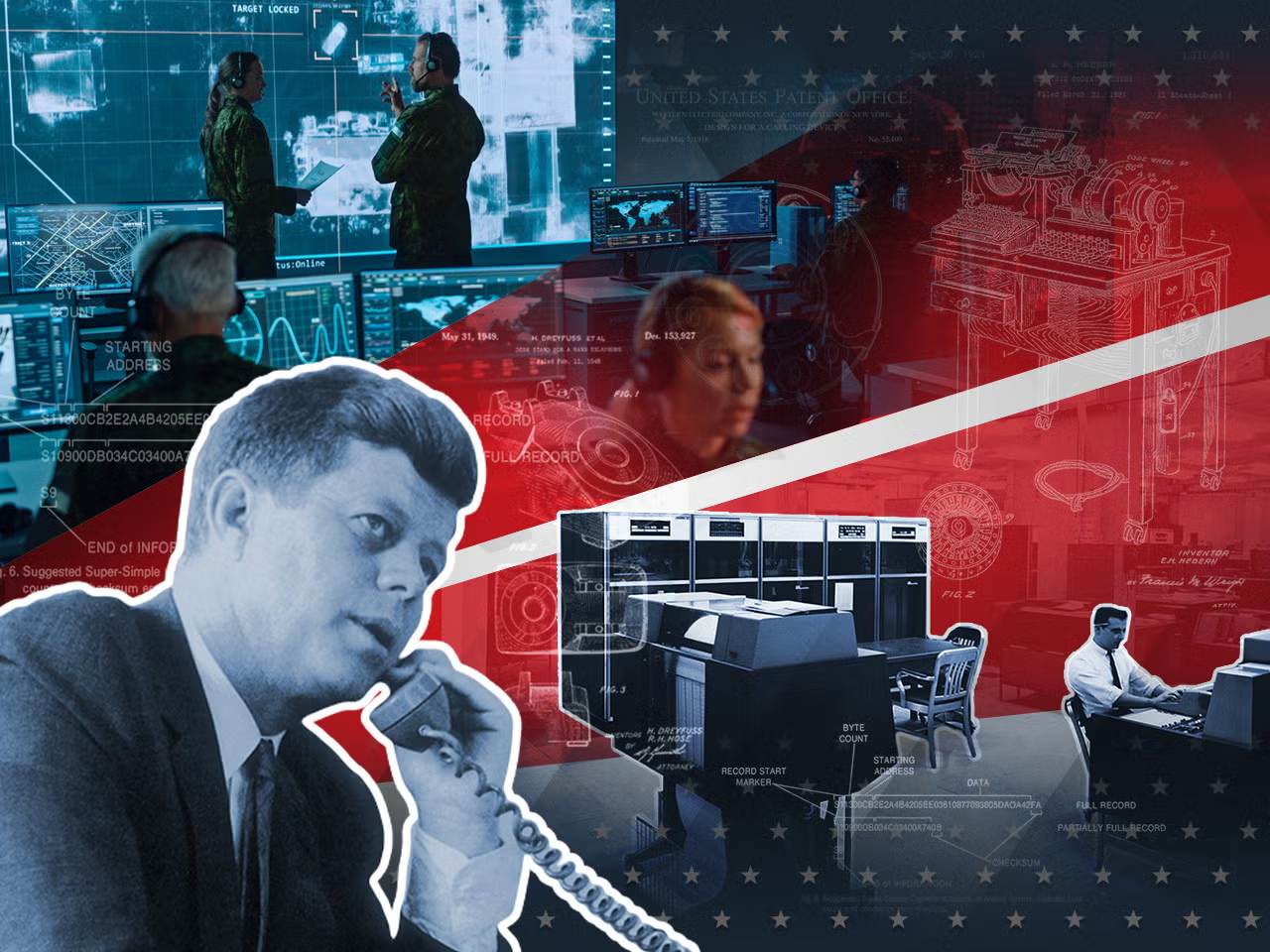
After the Cuban Missile Crisis pushed the United States and Soviet Union dangerously close to nuclear conflict in 1962, both governments recognized a terrifying reality: during moments of crisis, delayed or misunderstood communication between world leaders could have catastrophic consequences. The result was the Washington-Moscow Hotline, established in 1963 to create a direct line of communication between the White House and the Kremlin.
Popular culture later turned it into the famous “Red Phone,” but the real system – built by L3Harris’ legacy company, Harris Corporation – looked nothing like Hollywood portrayed. There was no bright red telephone sitting on a president’s desk. The original hotline actually relied on secure text-based communications transmitted through transatlantic cables and backup radio links. Text was intentionally chosen over voice communications to reduce the risk of mistranslation, emotional exchanges or misunderstood accents during moments of extreme geopolitical tension.
The hotline became one of the defining symbols of Cold War crisis management and a powerful reminder that communications technology can shape global stability just as much as military power. Why that’s honestly kind of wild: A secure messaging system may have helped prevent accidental nuclear war between superpowers.
Today, resilient communications between leaders in times of crisis remain just as critical. L3Harris is helping support that mission through technologies designed to maintain assured connectivity in highly contested environments, including work supporting the U.S. Air Force’s Survivable Airborne Operations Center program.
From airborne mission systems to secure communications networks, L3Harris continues advancing technologies designed to help leaders and operators stay connected during the moments when communication matters most.
3. Technology built to track storms is now helping to track hypersonic missiles.
Before satellites, weather forecasting depended heavily on ground observations and a significant amount of uncertainty. That changed when the United States began pioneering weather observation from orbit in the 1960s, giving scientists the ability to monitor storms, cloud systems and atmospheric activity across enormous regions of Earth in near real time.
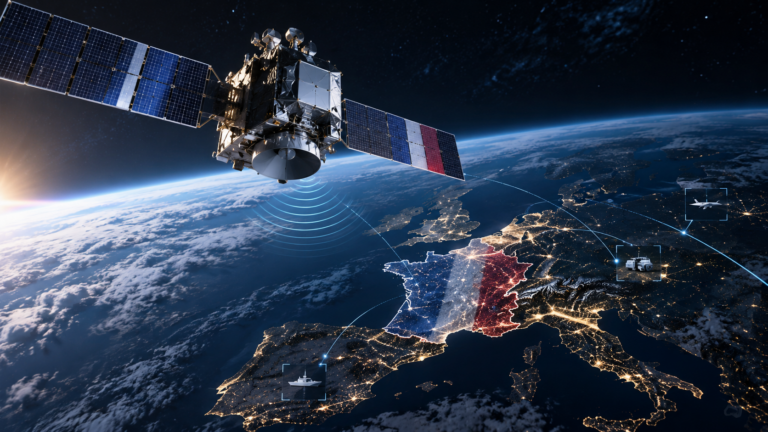
For decades, L3Harris and its heritage companies have helped build weather-monitoring satellites and infrared sensing systems capable of detecting subtle heat signatures in Earth’s atmosphere. Those systems process enormous amounts of data in real time to help forecasters track hurricanes, tornadoes, severe storms and other rapidly evolving weather events.
But over time, our team understood that adjacent and relevant capabilities were possible: many of the same infrared sensing technologies used to track storms could also help track missile threats from space.
“Missile defense is a high-throughput, low-latency mission in the infrared as well,” Rob Mitrevski, President of Golden Dome Strategy and Integration at L3Harris, explained in a recent interview. “So we took that sort of very deep infrared knowledge…and we applied it to a different data product.”
Today, some of the same sensing principles used to track storms are also being applied to tracking hypersonic missiles — fast, maneuverable threats that generate subtle heat signatures as they move through Earth’s atmosphere at speeds exceeding Mach 5.
Hypersonic glide vehicles present an especially difficult challenge because they are fast, maneuverable and comparatively dim compared to traditional ballistic missiles. Detecting them requires advanced infrared sensing, rapid data processing on board satellites and sophisticated algorithms capable of filtering through clouds, atmospheric effects and other background noise.
Why that’s honestly kind of wild: Technology originally designed to monitor hurricanes and severe storms is now helping track hypersonic missiles moving faster than Mach 5.
Today, L3Harris is applying decades of infrared sensing expertise to advanced missile warning and tracking systems designed to help operators detect dim, maneuverable threats from space in real time. What began as weather observation technology has evolved into a critical part of the future missile defense mission.
4. The world’s deepest tweet was sent from nearly seven miles underwater.
In 2012, filmmaker and explorer James Cameron descended nearly 11 kilometers into the Challenger Deep in the Mariana Trench—the deepest known point in Earth’s oceans—during the Deepsea Challenger expedition.
At the bottom of the trench, roughly 35,787 feet below sea level, Cameron sent what became known as the world’s deepest tweet. The message was transmitted using advanced L3Harris acoustic modem technology capable of sending communications through one of the harshest and most isolated environments on the planet.
The tweet read: “Just arrived at the ocean’s deepest point. Hitting bottom never felt so good.”
The achievement highlighted just how far communications technology had advanced. Conditions at the bottom of the Mariana Trench include crushing pressures exceeding 1,000 times atmospheric pressure at sea level, complete darkness and near-freezing temperatures, an environment so extreme that relatively few human beings have ever visited it.
Yet engineers still found a way to maintain communications from the deepest point on Earth back to the surface world.
Why that’s honestly kind of wild: A social media message was transmitted from one of the most extreme environments humans have ever explored.
Today, L3Harris continues advancing technologies designed for demanding undersea environments, including systems supporting next-generation Navy submarines operating far beneath the ocean’s surface. From communications to sensing technologies, the company helps support missions in places humans were never naturally meant to operate.
5. A Mars rover built to last 90 days survived for nearly 15 years.
When NASA launched the Opportunity rover to Mars in 2003, engineers designed the mission to operate for approximately 90 Martian days—known as sols—on the planet’s surface. While mission teams hoped the rover would exceed its planned mission life, few could have predicted the extent of its longevity.
Instead, Opportunity continued operating on Mars for nearly 15 years.
Over the course of its mission, the rover traveled more than 28 miles across the Martian surface, surviving dust storms, freezing temperatures and countless engineering challenges while transmitting an enormous amount of scientific data and imagery back to Earth through L3Harris transceivers. Opportunity ultimately operated for more than 5,000 sols before NASA declared the mission complete in 2019.
The mission became one of NASA’s most successful robotic exploration efforts in history and demonstrated something larger about innovation itself: sometimes the technologies people build prove capable of far more than anyone originally imagined.
Why that’s honestly kind of wild: A robot designed to survive for three months ended up exploring another planet for nearly a decade and a half.
Today, L3Harris communications technologies help enable a new generation of space missions, providing communications solutions that support the transmission of data, imagery and scientific insights across vast distances between spacecraft and Earth. As missions venture farther from our planet and operate in increasingly demanding environments, resilient communications remain essential to turning exploration into discovery.
6. GPS started as a military capability, and became part of daily life for billions of people.
GPS was originally developed by the U.S. Department of War during the Cold War to provide precise positioning, navigation and timing for military operations. Early systems were designed primarily to support warfighters, aircraft, ships and missile guidance with highly accurate location data anywhere on Earth.
Over time, however, GPS expanded far beyond military applications. What began as a national defense capability quietly became one of the invisible foundations of modern daily life.
Today, GPS helps power navigation apps, emergency response systems, aviation, agriculture, financial networks, shipping logistics and global commerce. Billions of people rely on GPS every day, often without even thinking about where the signals originate or how much infrastructure is required to keep the system functioning.
Entire industries now depend on ultra-precise timing and positioning data transmitted continuously from satellites orbiting thousands of miles above Earth.
Why that’s honestly kind of wild: A military navigation system became one of the invisible foundations of modern civilization.
Behind the scenes, GPS requires enormous technical infrastructure maintenance, and L3Harris has supported that mission from the very beginning. The company’s technologies were part of the first GPS satellites launched in 1978, including code generators and transmitters. Since then, L3Harris payloads and components have flown on every U.S. GPS satellite across more than 70 missions. Through those contributions, L3Harris has helped make GPS technology more accurate, resilient and dependable for users around the world.
At the same time, L3Harris is transforming position, navigation and timing (PNT) to meet 21st-century warfighter needs with experimental programs such as NTS-3. As the only company supporting GPS across the entire enterprise—from spacecraft and payloads to ground systems, user equipment and modernization efforts—L3Harris is demonstrating what is possible for the next generation of space‑based PNT. As jamming and spoofing threats continue to evolve, L3Harris navigation and anti-jam solutions help provide the resilience, security and reliability needed to maintain mission effectiveness when GPS is challenged.