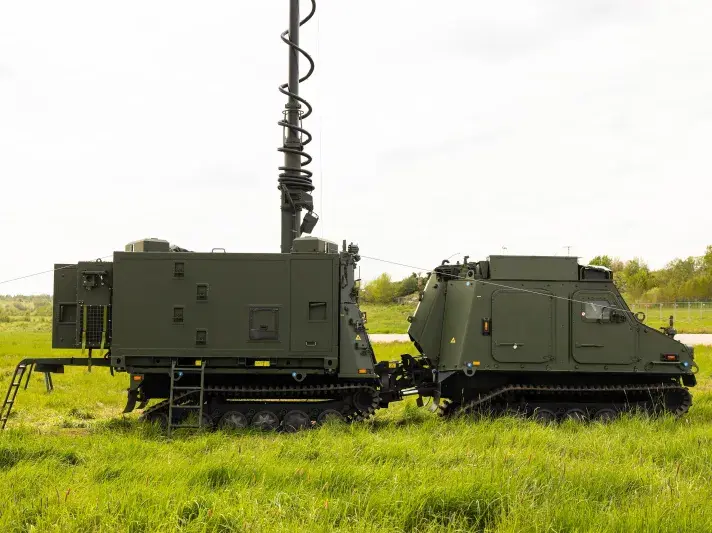

Elbit Systems Sweden has introduced its Tactical High Mobility Shelter, a rapidly deployable communications and sensor platform developed to support increasingly dispersed land forces.
Known as THMS, the system was launched at DALO Industry Days in Denmark during August. It is designed to operate as a mobile forward communications and sensing node, extending both line-of-sight and beyond-line-of-sight connectivity for units operating away from fixed command infrastructure.
The system has been developed and manufactured in Sweden and is intended for operation in demanding environments, including Arctic conditions. Its modular design allows different mission equipment to be installed depending on operational requirements.
Communications move with the force
THMS uses a telescopic mast that can extend to 25 metres and support payloads weighing up to 100kg. Elbit Systems said the mast can be deployed in less than five minutes using an automated deployment and guying system.
Possible payloads include tactical communications equipment, electronic warfare systems, electro-optical and infrared sensors, surveillance equipment, satellite communications, tactical 5G technology and high-power laser systems. The shelter can be integrated with both wheeled and tracked platforms.
The system also incorporates its own power generation, allowing it to operate independently from its host vehicle for up to 24 hours.
This type of mobility is becoming increasingly relevant as land forces move away from reliance on large static command posts. Concentrated headquarters and communications infrastructure can be easier to detect and target, particularly where opposing forces have access to uncrewed reconnaissance, electronic surveillance and long-range precision weapons.
Distributed networks require communications and sensors to move with the formations they support rather than remaining tied to permanent infrastructure.
Modular architecture supports multiple roles
Elbit Systems has positioned THMS as more than a communications platform. The ability to install different sensor and mission packages means the same basic system could be configured for communications, surveillance, electronic warfare or other battlefield roles.
The company previously demonstrated the technology during a large-scale digitised land-force exercise involving European and NATO participants. During that demonstration, equipment was used to maintain communications and information exchange between mobile operational elements.
For procurement teams, the development reflects a wider movement towards modular battlefield infrastructure. Rather than purchasing separate fixed systems for individual functions, armed forces are increasingly examining platforms that can accept different communications, sensing and mission payloads as requirements develop.
That approach can also allow new technologies to be introduced without replacing the underlying mobility platform.
THMS therefore illustrates how battlefield digitisation is increasingly being addressed at the infrastructure level: ensuring the networks connecting soldiers, vehicles, sensors and command systems remain mobile enough to operate alongside the units that depend on them.